
See what the passage actually says.
A 248-page field guide that teaches one clear method, in five moves, for reading any part of the Bible with care. Keep it beside your Bible and open it whenever a passage deserves a closer look.
- 38 chapters in five parts, from finding your bearings to a full passage study
- Real passages worked all the way through, step by step
- Printable worksheets and quick-reference sheets you can use again and again
- Fair to every Christian tradition, honest about what's still open

You've read it for years. But closely?
The Field Guide doesn't hand you conclusions. It teaches you how to read, so you can see what's there, weigh what you hear, and say honestly what you know and what you don't.
The Field Method
Each move has its own part of the book. Learn them in order, or turn straight to the one you need.
LocatePart one: Find your bearings
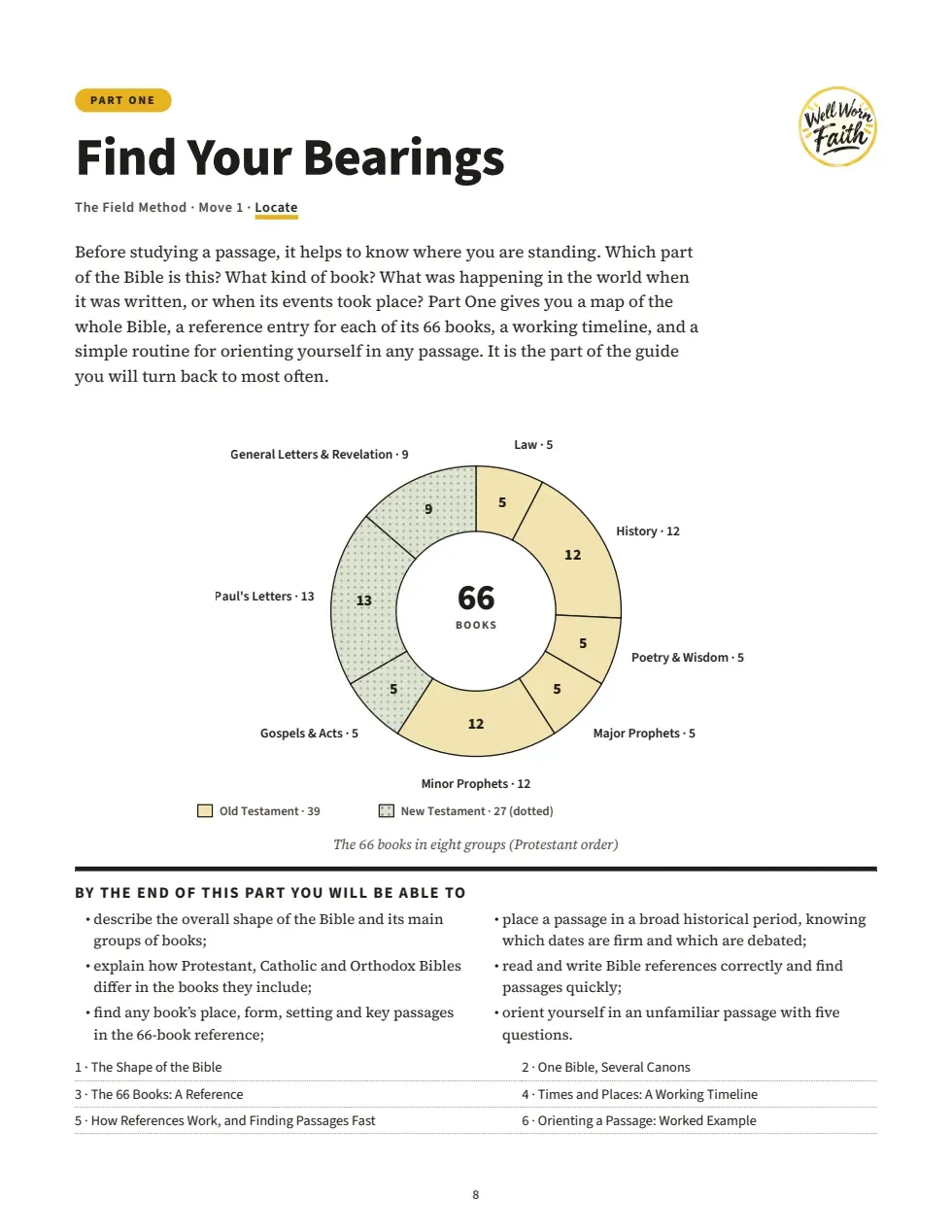
Where the passage sits: which book, what setting, what period, where it begins and ends. With a reference entry for all 66 books and a working timeline.
ObservePart two: Read what is actually there
See what the text says before deciding what it means. Who is speaking, to whom, what repeats, what contrasts, what connects.
Identify the formPart three: Recognize the kind of writing
Narrative, poetry, wisdom, prophecy, gospels and parables, letters, apocalyptic. What each kind of writing is, and the questions it asks of you.
TestPart four: Test the interpretation
Weigh a reading by the evidence: cross-references, translations, background and reference books. And how to handle real disagreement fairly.
RecordPart five: Put the method to work
The complete passage study, step by step. Then four full worked studies and three hard passages, done in front of you.
Real pages from the guide
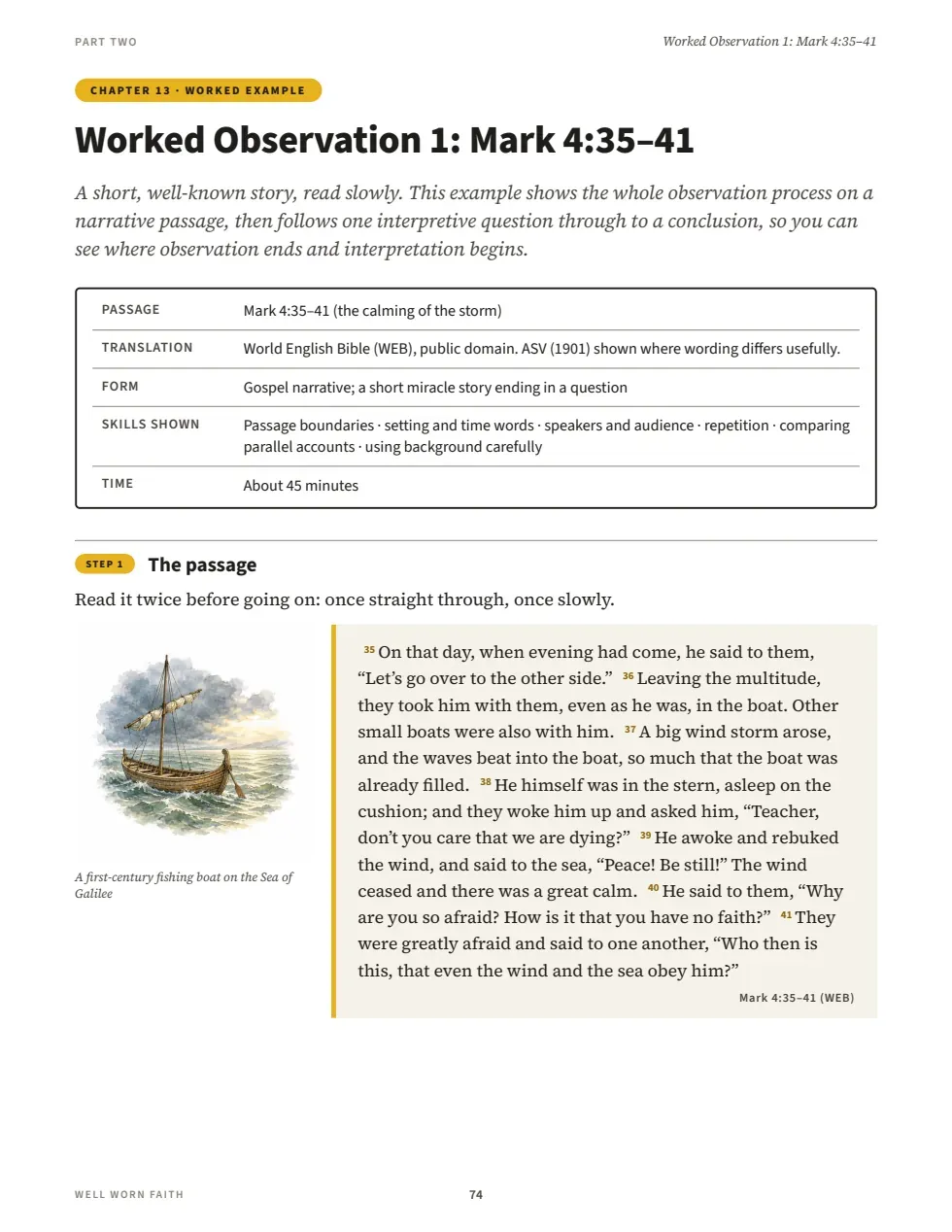
Clear type, generous margins, and every verse printed in full, so you can follow along with your own Bible open.
Tap a page to see it larger.
Verses often quoted without their context
Some verses travel far from home: onto mugs, cards and wall art. The guide reads five of them back in place, with care and respect. Each one gets the same treatment: how it's commonly used, the verse in its setting, what changes, and what doesn't.
- Jeremiah 29:11a promise for the future
- Philippians 4:13strength for anything
- Matthew 18:20a small gathering
- Matthew 7:1judging others
- Proverbs 29:18vision and leadership
Everything in the guide
38 chapters
- The shape of the Bible, and why its order isn't the order things happened
- One Bible, several canons: Protestant, Catholic and Orthodox
- Where a passage begins and ends
- Asking better questions of a passage
- Eight habits that jump to conclusions
- Seven kinds of biblical writing
- Comparing translations
- When Christians read a passage differently
Done in front of you
- Habakkuk 3:17–19 orienting a passage
- Mark 4:35–41 the calming of the storm
- Philippians 4:4–9 a letter
- Luke 10:38–42 Martha and Mary
- Genesis 50:15–21 "God meant it for good"
- Psalm 90 "teach us to count our days"
- Luke 18:9–14 the Pharisee and the tax collector
- 2 Corinthians 12:1–10 the thorn in the flesh
- Three hard passages Judges 11, Mark 16, Hebrews 6
Worksheets and more
- The Bible Map and the Orientation Sheet
- Observation Checklist and two Observation Records
- Genre Check and Translation Comparison
- Interpretation Record and Source Evaluation Checklist
- Passage Study Record and Final Study Checklist
- The Field Method card for your Bible
- Practice passages with suggested answers
- Glossary, further resources and a Scripture index
Careful with the text, fair to the reader
“They read in the book, in the law of God, distinctly; and they gave the sense, so that they understood the reading.”Nehemiah 8:8 (WEB)
For people who want to read closer
- 248-page PDF, US Letter, ready to read or print
- Five parts, 38 chapters, the full Field Method
- Worked studies on real passages
- Printable worksheets and quick-reference sheets
- Practice exercises with suggested answers
Your download link arrives by email straight after checkout. Not for you? Email us within 7 days of buying for a full refund.
Good to know
Is this a devotional?
No. It's a study guide: a method and a reference for reading biblical texts carefully. It isn't a devotional program, a counseling resource, or a substitute for pastoral care.
Which Bible do I need?
Whichever one you normally read. The guide quotes the World English Bible because it's in the public domain, so every verse can be printed in full. A second translation beside you makes the method even easier.
Does it take sides between churches?
No. It's written for readers in any tradition and doesn't speak for any church. Where Christians read a passage differently, it lays out the main views and the evidence each one draws on, and points you to your own church for its teaching.
I've read the Bible for years. Is this too basic?
Part One starts with the shape of the Bible, so newer readers aren't left behind. From there it goes well beyond the basics: forms of writing, comparing translations, weighing background claims, and hard passages where the honest answer is "not settled."
Is it a printed book?
No, it's a PDF. Read it on a computer or tablet, or print it at home. You may print the guide, and copy its worksheets and reference sheets, for your own study and for a study group you lead.
How do I get it?
Click "Get the Field Guide," complete the secure checkout, and we'll email you the download link straight away. If it doesn't arrive, check your spam folder, or email support@geniosity.co.
What if it isn't for me?
Email us at support@geniosity.co within 7 days of buying and we'll refund you in full. No forms, no fuss.
Start with something free.
Our short guide, Listening for the Long Haul, gives you four checks from Scripture for weighing what you sense, and five people in the Bible who kept walking with God into old age. We'll send it by email.
It's free. We'll email you the guide, then the occasional note from Well Worn Faith. Unsubscribe any time.